The Tree That
Stayed With Me
On moving, growing up, and finding a place for our questions among the branches of Yoko Ono’s Wish Tree.
Moving is a strange way to discover how much of your personality depends on knowing where things are.
The grocery store. The turn before your street. The particular arrangement of a place you’ve stopped having to look at because, somewhere along the way, it became yours. Then you move, and suddenly you have to pay attention again. Even buying toothpaste requires navigation. Very humbling for someone who would like to consider herself an emerging intellectual.
I used to think growing up would feel like gradually receiving answers. Adults seemed to have so many. Where to go, what to say, which envelope contained something important enough to ruin an afternoon. Surely, at some age, the world would begin explaining itself.
Instead, I’ve gotten older, moved, and developed additional questions. Excellent. More things to unpack.
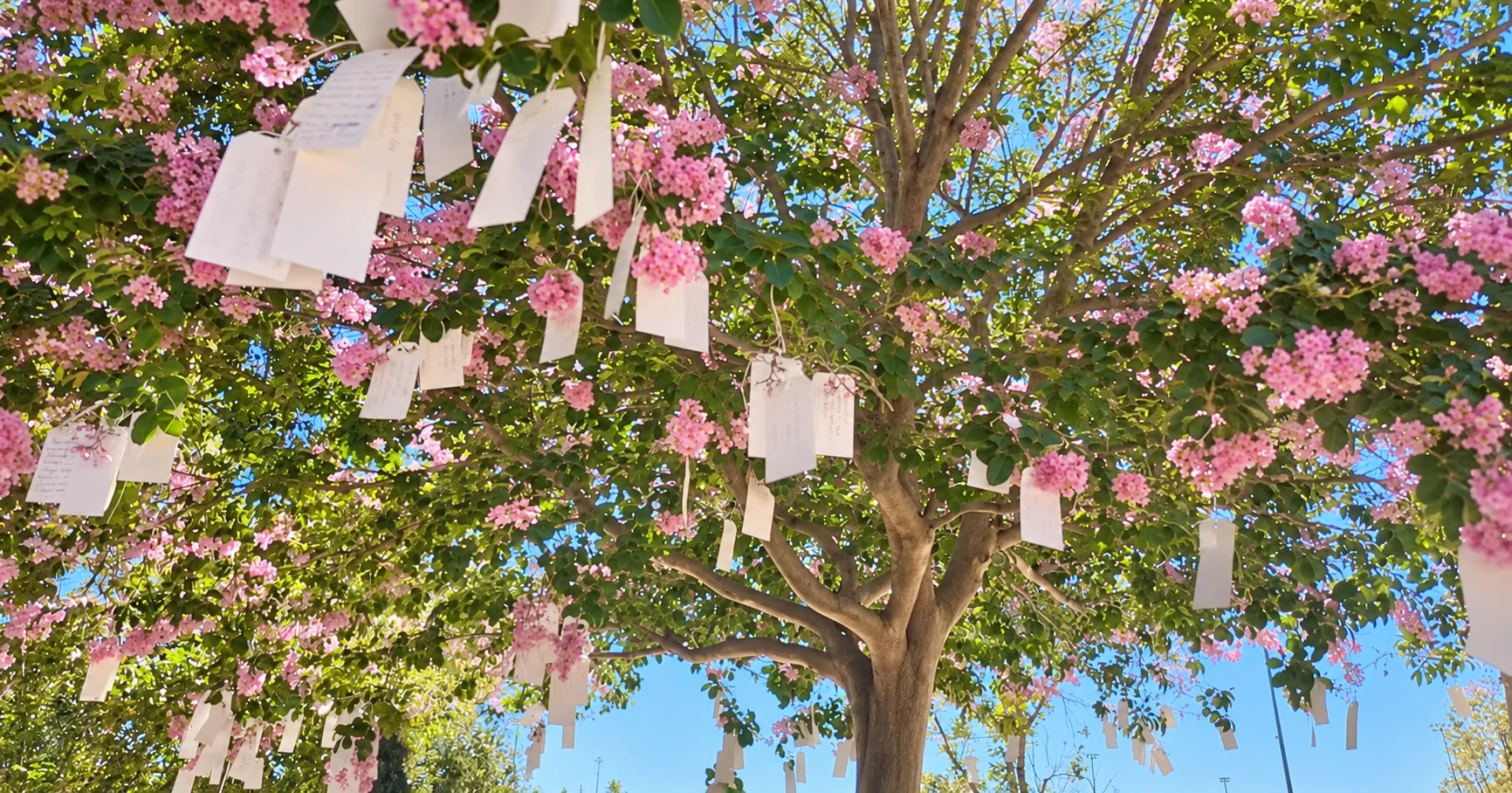
At Daisy Chain Fields in Irvine, one of those questions found somewhere to sit.
A tree, specifically.
Yoko Ono’s Wish Tree invited people to write a wish on a paper tag and tie it to a branch. There were tags hanging among the pink blossoms, little rectangles of somebody’s inner life made available to the weather. At a festival featuring Olivia Rodrigo, it felt almost ridiculous that paper could hold my attention like that. And yet.
What would you wish for?
A manageable question, theoretically. I have wishes. I would like to know what I’m doing with my life. I would like everyone I love to remain conveniently within reach. I would appreciate a future that provides some indication of what it wants from me before I commit to a major.
But putting a wish into words means choosing. Of everything you want to change, what gets the small piece of paper?
When I was younger, my world was small enough that my own problems could occupy most of it. Being understood. Being included. Becoming someone I could stand to be. Those things still matter to me; I haven’t evolved beyond wanting people to like me just because I now occasionally read the news.
But the world keeps getting in.
I hear an adult explain how something works and catch myself wondering who decided it should work that way. I see a place being called a community and wonder who feels comfortable there. I think about moving, about the ordinary disorientation of starting again, and become aware of how little that tells me about someone who never had a choice in leaving.
My experience gives me a starting point. It does not give me everybody else’s story.
That seems like something I should have understood earlier. A considerable portion of growing up, I’m discovering, involves having a revelation and then realizing other people have been patiently waiting for you to arrive.
The tags made that larger world feel close. Each one required someone to stop, choose words, and leave them where another person might look. I couldn’t know an entire life from a wish. I could recognize that there was an entire life behind it.
There is something uncomfortable about becoming aware of how much needs changing while still needing help with your own life. I can question institutions and also text my mother a question she has answered three times. Both are apparently allowed to happen on the same afternoon.
A wish won’t resolve that discomfort. Paper tied to a branch cannot do the work of making the world kinder. But I think there is value in a public place that asks us to name what we hope for—and lets us encounter hopes we might never have thought to ask about.
I’m still learning this place. I’m still figuring out what it means to belong somewhere without expecting it to become familiar immediately.
For now, I have a tree I remember.
Next time I pass through the park, I’ll know to look up.